


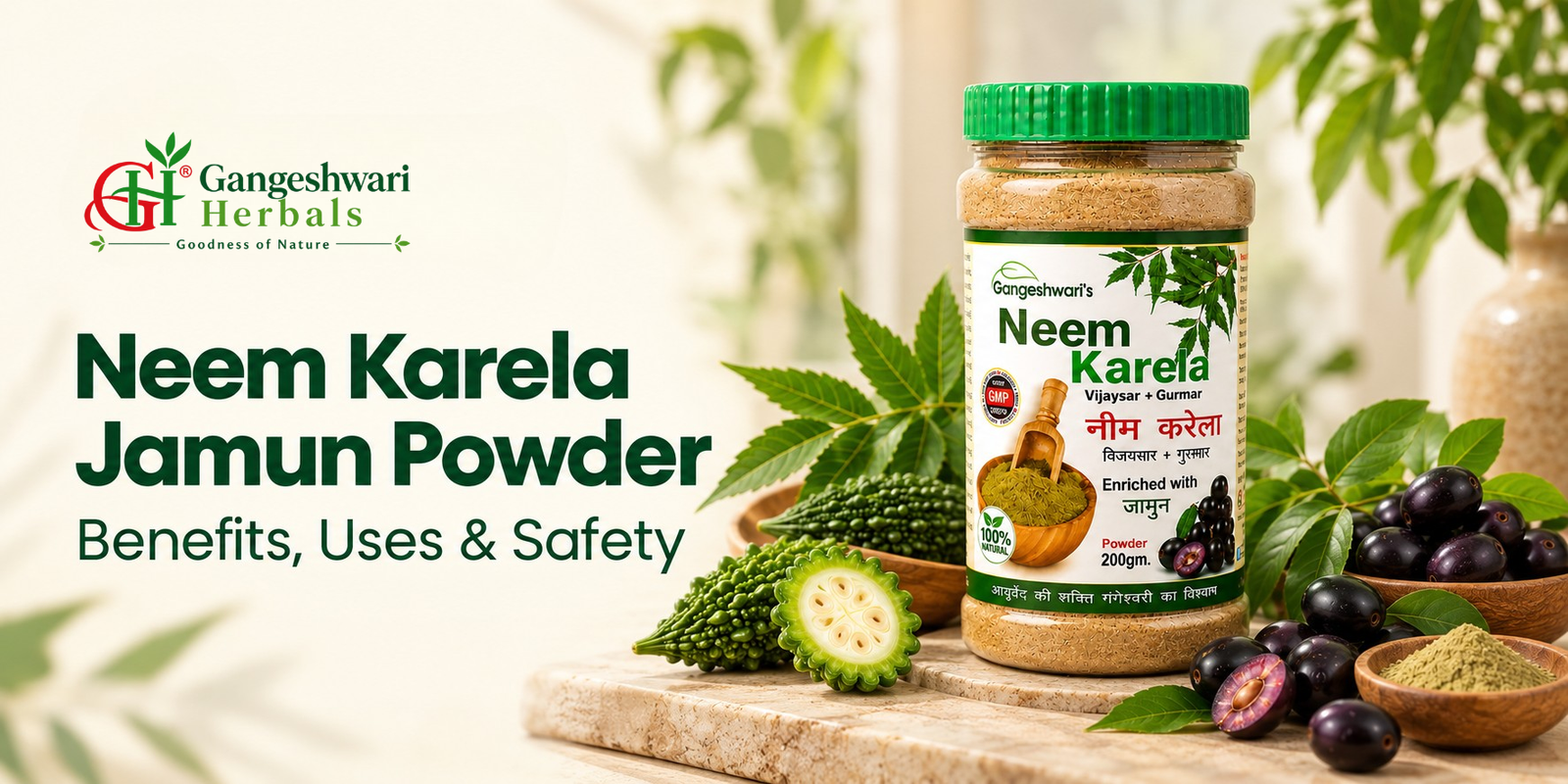
Neem Karela Jamun Powder is a herbal blend made with neem, bitter gourd (karela), and jamun. These ingredients have been used in traditional Indian wellness practices, particularly those associated with metabolic health. However, their traditional uses do not mean the combined powder is clinically proven to treat diabetes or other conditions.
If you’re considering this herbal product, understanding its ingredients, possible benefits, safety concerns, and quality is essential.
This guide explains what Neem Karela Jamun Powder contains, what scientific research suggests, how different formulations compare, and what to check before buying in India.
What Is Neem Karela Jamun Powder?
Neem Karela Jamun Powder is a powdered herbal preparation typically containing ingredients derived from three plants:
- Neem: A traditional Indian medicinal plant.
- Karela: Also called bitter gourd or bitter melon.
- Jamun: A seasonal Indian fruit whose seeds are used in some herbal formulations.
The powder is commonly discussed in the context of Ayurveda and traditional wellness routines.
However, not every product contains the same ingredients or quantities. Some manufacturers combine these herbs with additional ingredients such as gurmar, vijaysar, or amla.
Therefore, checking the actual formulation is more important than relying on the product name alone.
Key Ingredients in Neem Karela Jamun Powder
Each ingredient has a different botanical background and traditional application.
1. Neem (Azadirachta indica)
Neem is widely known in India for its use in traditional medicine and personal care.
Its leaves and other plant parts contain naturally occurring compounds investigated in laboratory research.
Although some studies have explored neem’s biological properties, evidence is insufficient to establish that oral neem powder treats diabetes.
2. Karela (Momordica charantia)
Karela, or bitter gourd, is a familiar vegetable in Indian households.
Researchers have investigated bitter melon compounds for their possible effects on glucose metabolism, which describes how the body processes and uses sugar.
However, human studies have produced inconsistent results. The available evidence does not establish karela supplements as effective diabetes treatments.
3. Jamun (Syzygium cumini)
Jamun is a purple seasonal fruit consumed across India.
In traditional preparations, jamun seeds are sometimes dried and powdered. Researchers have studied compounds found in the fruit and seeds, including their potential biological activity.
However, findings from laboratory studies cannot automatically be applied to commercially available herbal powders.
Neem, Karela and Jamun Ingredient Comparison
| Ingredient | Botanical Name | Traditional Association |
| Neem | Azadirachta indica | Traditional herbal wellness |
| Karela | Momordica charantia | Metabolic wellness traditions |
| Jamun | Syzygium cumini | Traditional food and herbal preparations |
Important: The part of the plant used, ingredient concentration, and preparation method can affect a product’s composition and safety.
Potential Benefits of Neem Karela Jamun Powder
Consumers often research Neem Karela Jamun Powder benefits because its ingredients have longstanding associations with traditional wellness.
However, traditional knowledge and clinical evidence should be considered separately.
1. Traditional Association With Metabolic Wellness
Neem, karela, and jamun have been used in traditional practices relating to metabolic health.
Scientists have investigated individual ingredients for possible effects on blood glucose regulation.
However, there is insufficient reliable clinical evidence to conclude that the combined powder effectively manages diabetes.
2. Naturally Occurring Plant Compounds
These plants contain various phytochemicals, which are compounds naturally present in plants.
Some have shown antioxidant activity in laboratory studies.
However, this does not establish that consuming Neem Karela Jamun Powder produces measurable antioxidant or disease-prevention benefits in humans.
3. Convenient Powdered Format
Powdered herbal preparations may appeal to adults who prefer products that can be measured and prepared according to labelled instructions.
This convenience is a practical characteristic, not proof of medical effectiveness.
Ultimately, the potential value of any formulation must be considered alongside its quality, safety, and supporting evidence.
What Does Scientific Research Say?
Research on herbal ingredients continues, but the strength of evidence varies considerably.
According to the National Center for Complementary and Integrative Health (NCCIH), research has not established herbal supplements, including bitter melon, as effective treatments for diabetes.
A scientific review of dietary supplements for diabetes also reported inconsistent findings from bitter melon studies.
Researchers have noted several limitations:
- Small numbers of participants.
- Differences in formulations and quantities.
- Short study durations.
- Inconsistent clinical outcomes.
Furthermore, research on individual ingredients does not prove that a commercial combination produces the same effects.
Diabetes Statistics in India
The importance of reliable health information becomes clearer when considering India’s diabetes burden.
The ICMR-INDIAB study published in The Lancet Diabetes & Endocrinology in 2023 estimated that, based on 2021 projections:
- 101 million people in India were living with diabetes.
- 136 million people were living with prediabetes.
These figures highlight the importance of appropriate screening, medical guidance, and evidence-based diabetes management.
They do not demonstrate that herbal powders can prevent or treat diabetes.
How to Use Neem Karela Jamun Powder
Usage depends on the specific product’s composition and instructions.
How Is the Powder Prepared?
Some powdered formulations are intended to be mixed with water or another beverage.
Before using a product:
- Read the full ingredient list.
- Check the manufacturer’s preparation instructions.
- Follow the labelled serving recommendations.
- Avoid combining several herbal products without medical guidance.
- Consult a healthcare professional if you take medication or have a health condition.
What Is the Best Time to Take It?
There is no universally established best time to consume Neem Karela Jamun Powder.
Manufacturers may provide different instructions depending on their formulations.
Rather than following general online dosage advice, assess the product’s directions and your individual medical circumstances with a qualified professional.
Disadvantages and Side Effects of Neem Karela Jamun Powder
Natural ingredients can still cause unwanted effects. Safety should be considered before using any concentrated herbal preparation.
1. Digestive Discomfort
Some bitter melon preparations have been associated with gastrointestinal symptoms, including abdominal discomfort and diarrhoea.
The effects of a combined product may differ depending on its ingredients.
2. Medication Interactions
Herbal products may interact with prescription medicines.
People taking insulin or other glucose-lowering medicines should seek medical guidance before using a supplement containing these herbs.
Combining treatments without appropriate supervision may increase the risk of adverse effects.
3. Limited Long-Term Safety Information
Long-term safety data for many commercial multi-herb powders remain limited.
A product’s traditional history does not automatically establish the safety of regular or prolonged consumption.
4. Differences in Manufacturing Quality
Herbal products can vary in ingredient sourcing, processing, packaging, and quality-control practices.
Poorly labelled products may make it difficult for customers to understand exactly what they are consuming.
Who Should Consider Neem Karela Jamun Powder?
Adults interested in traditional herbal preparations may explore these products after reviewing their ingredients, evidence, and safety information.
However, herbal powders are not appropriate for everyone.
Who Should Seek Medical Advice First?
Additional caution is important for:
- People diagnosed with diabetes.
- Individuals taking regular prescription medication.
- People with kidney or liver conditions.
- Anyone with known allergies to herbal ingredients.
Pregnant or breastfeeding individuals and children should avoid self-medicating with these formulations, particularly when reliable safety information is unavailable.
Neem Karela Jamun Powder should not replace prescribed medicines, blood glucose monitoring, or professional medical care.
Neem Karela Jamun Powder vs Other Herbal Products
Different herbal products may have similar names but contain different ingredients.
Understanding these differences can help buyers make informed comparisons.
| Factor | Neem Karela Jamun Powder | Karela Jamun Powder | Jamun Seed Powder |
| Typical ingredients | Neem, karela, jamun | Karela, jamun | Jamun seed |
| Formulation | Multi-herb blend | Two-herb blend | Single ingredient |
| Preparation | Product-specific | Product-specific | Product-specific |
| Main buying consideration | Full blend composition | Two-herb combination | Seed quality and purity |
| Safety | Depends on formulation | Depends on formulation | Depends on formulation |
Neem Karela Jamun Powder vs Juice
Both formats may be available in different formulations.
Powdered products:
- Require preparation according to the label.
- May be convenient for measuring and storage.
- Differ in ingredient concentration and serving size.
Juice products:
- Are generally supplied in liquid form.
- May contain additional ingredients or preservatives.
- Have product-specific storage and usage instructions.
Neither format has established medical superiority for treating diabetes.
Choose according to verified composition, convenience, quality, and suitability rather than unsupported health claims.
How to Choose Quality Neem Karela Jamun Powder in India
If you are comparing herbal powders online, product transparency should be a priority.
1. Check the Complete Ingredient List
Look beyond the product name.
Confirm whether the formulation contains only neem, karela, and jamun or includes additional herbs.
Where available, review botanical names, plant parts, and ingredient quantities.
2. Verify Packaging Details
A product label should provide the information needed to identify and assess the product.
Check for:
- Manufacturer name and contact details.
- Batch number.
- Manufacturing and expiry dates.
- Net weight.
- Storage and usage instructions.
- Applicable licence or registration details.
3. Understand Regulatory Information
Different herbal products may fall under different regulatory categories in India.
For example, the Food Safety and Standards Authority of India (FSSAI) publishes standards for relevant food-supplement categories.
Ayurvedic medicines are subject to a separate regulatory framework. The Ministry of Ayush’s e-Aushadhi portal provides information about its licensing system.
A licence or registration should not be interpreted as proof that every advertised medical benefit has been clinically established.
4. Compare Price and Value
When shopping online, consider the price per 100 g alongside the formulation.
For example, two 200 g packs may have different prices because they contain different ingredients or use different manufacturing processes.
Also review seller details, packaging condition, delivery terms, and return policies.
5. Be Careful With Customer Reviews
Customer reviews can provide useful information about packaging, delivery, and product experience.
However, testimonials cannot establish whether a product treats a medical condition.
Practical Tips Before Buying Herbal Powders
A few simple checks can help avoid confusion.
- Read before buying: Check the full label instead of relying on attractive packaging.
- Verify the formulation: Similar product names do not guarantee identical ingredients.
- Check freshness: Look at manufacturing and expiry dates.
- Avoid exaggerated claims: Be cautious of guaranteed cures or promises of rapid results.
- Consider personal safety: Discuss potential medication interactions with a healthcare professional.
The most useful product information is specific, verifiable, and easy to understand.
Real Product Example: Why Ingredient Labels Matter
Consider the Gangeshwari Neem Karela Vijaysar Powder with Gurmar – 200g listed by Gangeshwari Herbals.
Its published product information identifies a multi-herb formulation mentioning ingredients such as neem, karela, jamun, vijaysar, gurmar, and amalaki.
This is not identical to a basic three-ingredient Neem Karela Jamun Powder.
A customer comparing these products should review the complete composition and labelled instructions rather than assuming both formulations are interchangeable.
The lesson: Ingredient transparency matters more than similarities in product names.
This example illustrates an actual product-listing comparison. It is not a clinical case study or a claim about customer health outcomes.
Frequently Asked Questions About Neem Karela Jamun Powder
1. What is Neem Karela Jamun Powder used for?
It is traditionally associated with herbal wellness practices, especially those relating to metabolic health. However, its effectiveness in treating medical conditions has not been established through sufficient reliable clinical evidence.
2. Can Neem Karela Jamun Powder cure diabetes?
No reliable clinical evidence establishes Neem Karela Jamun Powder as a cure for diabetes. It must not replace prescribed medicines, medical supervision, or recommended lifestyle management.
3. What are the main ingredients?
The commonly named ingredients are neem, karela, and jamun. Some commercial products contain additional herbs, so checking the complete label is important.
4. Can Neem Karela Jamun Powder be taken daily?
Daily use is not automatically suitable for everyone. Safety depends on the formulation, personal health, medication use, and professional guidance.
5. Does Neem Karela Jamun Powder have side effects?
Possible concerns include digestive discomfort and interactions with medicines. Risk varies according to the formulation, quantity consumed, and individual circumstances.
6. How do I choose genuine Neem Karela Jamun Powder?
Check the ingredient list, manufacturer details, batch number, expiry date, applicable regulatory information, and seller reliability. Avoid relying on unverified medical claims.
Conclusion
Neem Karela Jamun Powder brings together three ingredients associated with traditional Indian herbal practices.
While researchers have investigated compounds found in neem, karela, and jamun, the scientific evidence does not establish the combined powder as a proven treatment for diabetes.
Before choosing a product, understand its ingredients, review potential safety concerns, and compare formulations carefully.
A well-informed decision should be based on accurate product information rather than exaggerated promises.
Explore Herbal Formulations and Product Details
Interested in comparing traditional herbal preparations?
Explore the Neem Karela Vijaysar Powder with Gurmar – 200g to review the available product information, ingredient details, and pack specifications.
You can also browse the herbal product collection or request a product consultation if you have questions about available formulations.
Note: The linked product contains additional herbs and should not be confused with a basic three-ingredient neem, karela, and jamun powder. For personal medical suitability or medication-related questions, consult a qualified healthcare professional.
Medical Disclaimer: This article provides general educational information and does not constitute medical advice, diagnosis, or treatment. Herbal products may have side effects and interact with medicines. Consult a qualified healthcare professional before using any herbal formulation, especially if you have an existing medical condition or take prescription medication.